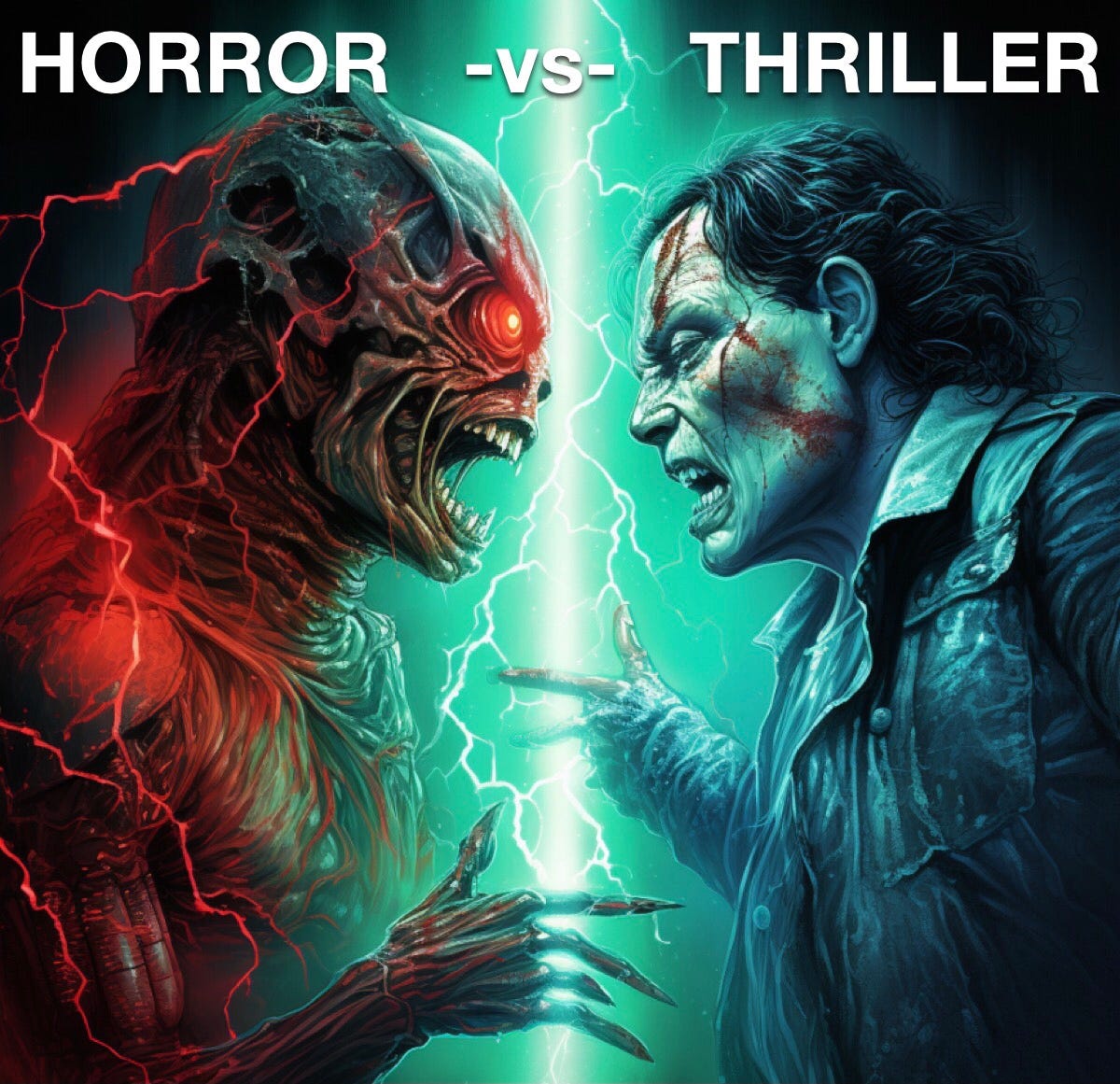
HORROR -vs- THRILLER
What's the difference between the closely related movie genres?
When it comes to movies, there’s nothing like a good suspenseful Thriller to keep you on the edge of your seat or a creepy Horror that has you spilling popcorn every time there’s a sneaky jump-scare! The feelings of fear and suspense audiences experience often overlap in both genres. So, what are the main differences between Horror and Thriller movies? After countless hours wasted in dark theaters and hundreds of thousands of dollars of student loan debt accumulated over the years, I’ve arrived at a rather simple, straight forward answer.
As I ponder the differences between Horror and Thriller, I’m reminded of an old gen-x joke that is wholly inappropriate by today’s standards. Not quoting directly but it goes something like, ‘what’s the difference between a bit** and a ho*? The ‘h’ blanks everybody while the ‘b’ blanks everybody but you.’ It’s all a matter of perspective. The same can be said about the main character (protagonist) in a Horror vs a Thriller. In a Thriller, the protagonist is pursuing something amid desperate circumstances. In a Horror, something is pursuing the protagonist amid dire circumstances. It’s a matter of being the pursuer (Thriller) -vs- the pursue-ee. (Horror) It’s the matter of a desperate situation where the protagonist could likely walk away without achieving the goal, albeit suffering great loss (Thriller) -vs- a dire life or death situation where achieving the goal is crucial for the protagonist’s survival (Horror).
Of course, there are no set hard and fast rules regarding stories and movies. And for pseudo-rules, there will always be plenty of exceptions especially in the production of art where creativity is at the core. Despite the exceptions, let’s look at a few solid examples.
HORROR
In the movie A Nightmare on Elm Street (1984), old crusty-face himself (Freddie Krueger) pursues and murders people in their dreams in this 80s horror classic. It’s both a dire situation and the main characters are being pursued by a monstrous antagonist.
In a more modern take on horror, Get Out (2017), the main character is being pursued but the pursuit begins subtly then quickly escalates from a desperate situation to a dire quest for survival.
In the movie, Night of the Living Dead (1968), a film some credit as the inspiration for the whole zombie-horror sub-genre, the main characters are pursued by the ‘living dead’ zombie creatures in a dire, world-wide apocalyptic situation.
Some Horror films spill over into the Action genre because of the elevated action sequences. The movie Alien (1979) is often considered an immensely entertaining sci-fi/action flick. But at the end of the day, it’s merely a monster-movie set in space; again, with a dire situation and the protagonist(s) being pursued by alien creatures (monsters).
THRILLER
In a movie like, Taken (2008), which arguably spawned its own sub-genre, the main character puts himself in a life-or-death situation in order to pursue the one thing he wants to acquire above all else (his daughters freedom). But what if Liam Neeson’s character refused the kidnappers’ demands and told them to keep his daughter because he could simply make another daughter and likely have a good time while doing it? Yes, it’d be an extremely short movie, but it’d be reasonable to assume the main character could go on living without much threat of being killed. Instead, the hero is so desperate to save his daughter, he won’t let anything stand in his way in his pursuit to save her.
In both Seven (1995) and Silence of the Lambs (1991), the main characters desperately pursue the ‘monster’, putting their lives at risk for some ‘higher calling’, but technically, they could just walk away and not risk their lives. Often times it is the ‘higher calling’ that helps differentiate a Thriller from a Horror and the ‘higher calling’ motif lends itself to thrillers often being centered around law enforcement, justice, retribution or revenge.
Combining elements from both Horror and Thriller genres has created some of the most entertaining action movies of all time
Terminator 2: Judgement Day (1991) and Aliens (1986) are not only two of the best action movies in history, but they are arguably two of the greatest sequels of all time, and not surprisingly both made by James Cameron.
The original films in these series both leaned more toward a classic Horror film structure where the killer cyborg in Terminator (1984) and the creature in Alien (1979) represented classical ‘monsters’ in relentless pursuit of the protagonists in each movie. In the aforementioned sequel movies, the main characters (pursue-ees) turned the tables and became the pursuers by going after the ‘monsters’ while following a ‘higher calling’. Sigourney Weaver’s character wanted to protect the orphaned child (Newt) and the Terminator was driven to protect the young John Connor.
*Note to anyone crafting a Horror franchise, a James Cameron-inspired cheat-code for the sequel is to push subsequent chapters more toward Thriller where the main character is fueled by a ‘higher calling’ and goes after the antagonist essentially reversing the pursuer/pursue-ee relationship. *
The next time you find yourself creating a story and you’re not sure if your story fits in the Horror or Thriller genre, ask yourself, ‘is there a monster (metaphorically speaking) chasing my main character, or is my main character chasing the monster (again a metaphor, something that must be stopped)? The answer to that question can help bring clarity to your story’s narrative journey.
By, Marlon G.
Can you think of any exceptions to the Horror vs Thriller genre parameters listed above? Share your exceptions in the comments!
If you would like to support this page, please make a one-time donation by clicking the button below.
Thanks.
See you next time.